
Creatine Cycling 101: The Physiology, Performance Impact, Weight Changes, and Whether You Should Cycle Off Before a Race
Creatine remains one of the most researched supplements for athletes, yet cycling — deliberately going on and off it — is still surrounded by confusion. Many endurance athletes ask: Should I cycle off before a big race to “reset,” drop water weight, or improve my power-to-weight ratio? Does staying on creatine long-term cause tolerance or downsides?
Here’s a clear, evidence-based breakdown of the physiology, what really happens when you cycle off, the truth about weight changes, and whether cycling off is smart for race day.

How Creatine Works in the Body (Quick Refresher)
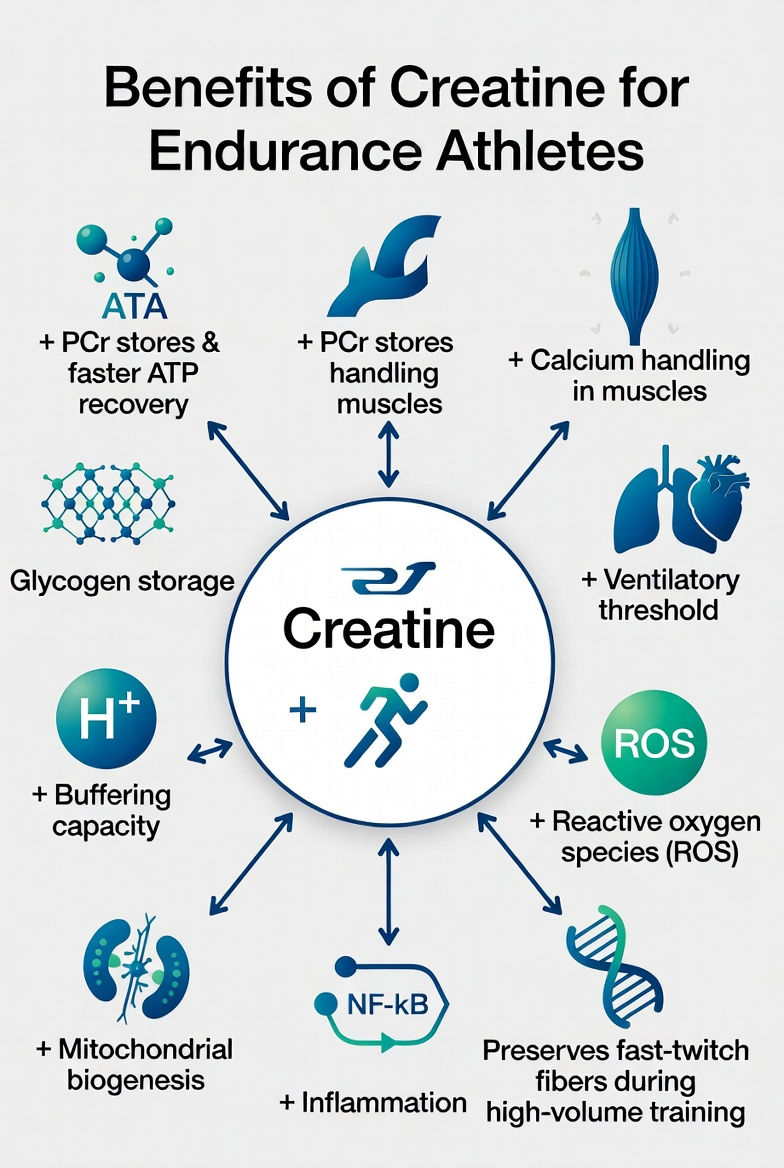
Creatine increases muscle phosphocreatine (PCr) stores, which rapidly regenerates ATP during high-intensity efforts. This improves power output, repeat sprint ability, recovery between intervals, and buffering of lactate.
Standard protocol: 5–7 day loading (20 g/day) followed by 3–5 g/day maintenance. Benefits appear within days and plateau after 3–4 weeks. Long-term continuous use (years) is safe and effective at 3–5 g/day in healthy athletes.
What Happens Physiologically When You Cycle Off Creatine?
Muscle creatine levels decline gradually — not overnight. Full return to baseline typically takes 4–6 weeks after stopping supplementation.
Key changes during the “off” phase:
PCr stores drop ~20–30% → Slower ATP regeneration during explosive efforts.
Intracellular water decreases → Temporary loss of muscle fullness and cell volumization.
No true “tolerance reset” — unlike caffeine, creatine does not downregulate receptors or cause diminished returns with continuous use.
Recent meta-analyses (Buford et al., 2007; updated 2023–2025 reviews) confirm there is no evidence that long-term continuous supplementation reduces endogenous creatine production or creates dependency.
The Weight Gain Question — and What Happens When You Cycle Off
Weight gain from creatine is real but often misunderstood.
Typical increase: 0.8–2 kg (1.8–4.4 lbs) within the first 1–4 weeks (mostly during loading).
Cause: Almost entirely intracellular water retention inside muscle cells + modest lean mass gains from improved training quality. It is not fat.
Supporting research: Meta-analyses (Pashayee-Khamene et al., 2024; Buford et al., 2007) show consistent 0.86 kg average body mass increase, with fat-free mass rising and body fat percentage often slightly decreasing when combined with training.
When you cycle off creatine, you do lose weight — but it’s mostly water:
Expect 1–2 kg loss over 4–6 weeks as creatine stores and associated water return to baseline.
This is gradual and reversible — not a true fat-loss effect.
Is Cycling Off Beneficial for Power-to-Weight Ratio?
This is the question many cyclists and runners care about most!
Short answer: For most athletes, no — staying on creatine is usually better for power-to-weight in real-world performance.
Here’s why:
The extra 1–2 kg of water weight can slightly lower your power-to-weight ratio on paper (especially for pure climbers or lightweight runners).
However, the performance gains (higher power output, better repeat sprints, faster recovery between efforts) typically more than compensate for the small weight increase.
Research shows net improvements in time-to-exhaustion, interval performance, and race times even with the modest weight gain (Forbes et al., 2023; TrainingPeaks and endurance-specific reviews).
In weight-sensitive sports (e.g., very steep hill climbs or lightweight categories), some athletes cycle off 4–6 weeks pre-race to drop water weight and optimize ratio short-term. But this comes with the risk of reduced power and slower recovery during the taper.
Strong research stance:
Meta-analyses confirm the weight gain is primarily water and reversible.
No high-quality studies show that cycling off improves race performance via better power-to-weight. Most evidence points the other way: continuous use provides a net ergogenic benefit that outweighs the minor ratio penalty for the majority of athletes.
Elite cyclists and triathletes who use creatine often stay on year-round and report better climbing power and sprint finishes despite the small weight increase.

Project Blue Recommendation
For most endurance athletes...
Continue creatine at 3–5 g/day (no need to cycle).
Only cycle off if you have a very specific reason (e.g., extreme weight sensitivity for a key climbing race or personal preference during a long off-season).
If you do cycle off, time it 2-4 weeks before an important race so you don’t lose benefits during taper.
Test your own response: Track power output, body weight, and perceived effort for 4–6 weeks on creatine, then again after cycling off. Most athletes see the performance upside clearly outweighs the scale number.
Creatine cycling is mostly myth and old-school bodybuilding tradition. The physiology and research strongly favor consistent use for better training quality, recovery, and race-day power — with or without the small water-weight change.
Have you ever cycled creatine? Did you notice a difference in weight, power, or race performance? Drop your experience in the comments — I read every one!


Comments